
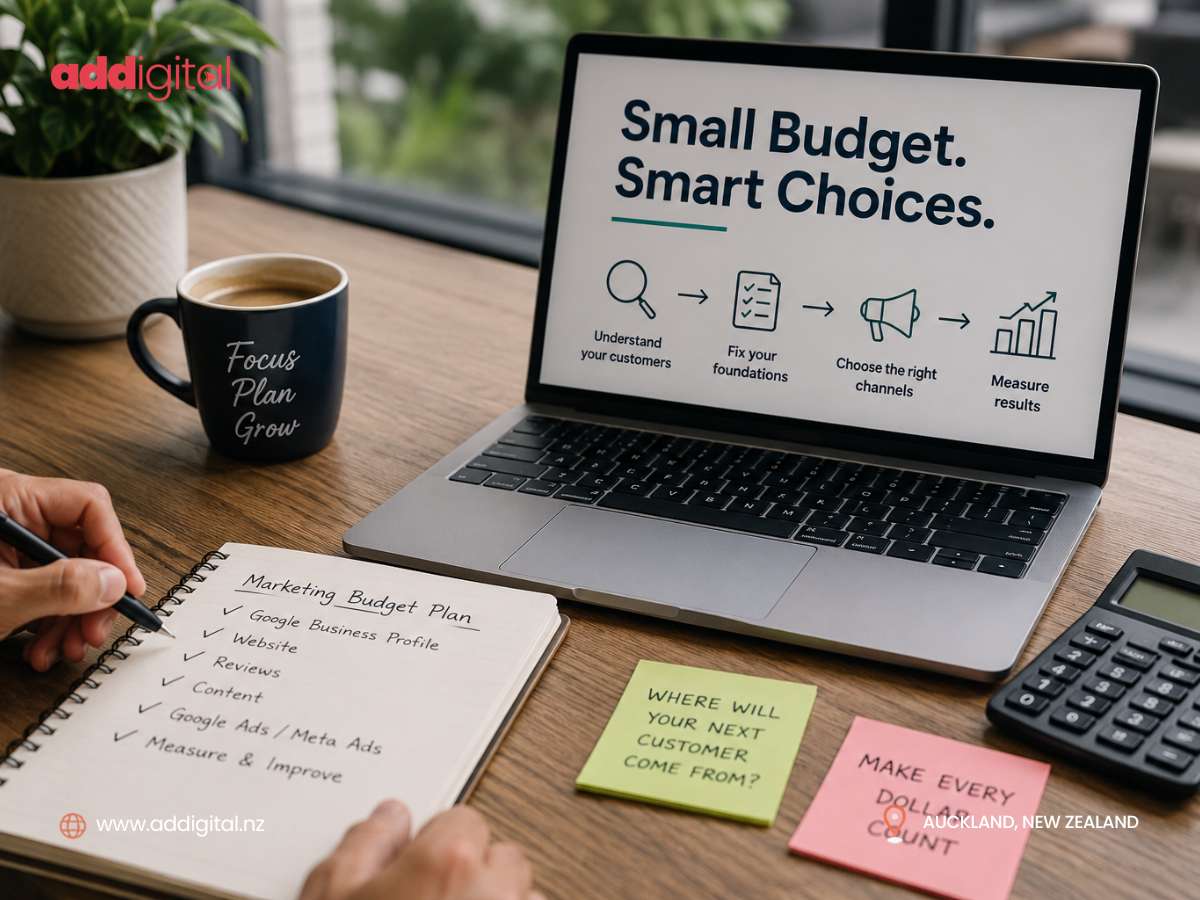
For many New Zealand small-business owners, the marketing question is not, “How much can we spend?”
It is usually closer to: “I have a limited amount available. What is most likely to make a difference?”
Perhaps you have $300, $500 or $1,000 a month. That may not be enough to run several advertising campaigns, redesign your website, produce regular videos and hire someone to manage everything.
But it can still be enough to make progress – provided the money is spent in the right order.
The biggest risk with a small marketing budget is not that the budget is too low. It is spreading it across too many disconnected activities and never giving any of them enough time or attention to work.
In this article
We will look at:
- what to check before spending money on advertising;
- where different types of businesses should prioritise their budget;
- when Google Ads or Meta Ads may make sense;
- and how to get more value from a modest monthly spend.
Start with the business problem, not the marketing channel
A marketing budget should begin with one question:
What does the business most need right now? That answer may be:
- more calls;
- more bookings;
- more people visiting the store;
- greater awareness in a particular Auckland suburb;
- more enquiries from business owners;
- or more repeat business from existing customers.
Until that is clear, choosing between Google, Facebook, Instagram, LinkedIn, email or a website becomes guesswork.
New Zealand’s Business.govt.nz recommends starting with an understanding of your customers and a clear marketing strategy rather than jumping immediately into advertising. It also emphasises planning campaigns and measuring their performance.
A local electrician who needs urgent job enquiries has a very different problem from a new café trying to become known in its neighbourhood. The electrician may benefit from appearing when someone actively searches for help. The café may gain more from local visibility, strong photography, customer reviews and regular social content.
The budget may be the same, but the right use of it is not.
First, make sure customers have somewhere trustworthy to land
Advertising can bring more people to your business, but it cannot automatically make them trust what they find.
Before paying for traffic, check the basics:
- Is your Google Business Profile accurate?
- Are your opening hours correct?
- Does your website clearly explain what you do?
- Is your phone number easy to find?
- Does the enquiry form work?
- Are there recent reviews?
- Do your photos still represent the business?
- Can someone understand why they should choose you?
An online presence helps a business look professional and makes it easier for customers to find it. That foundation may include a website, business email, social channels and accurate online information.
This does not mean everything must be perfect before you advertise. It means the customer journey should work.
Someone should be able to discover the business, understand the offer, develop enough confidence to take the next step, and then contact you without unnecessary friction.
A modest amount spent fixing that journey can sometimes create more value than spending the entire budget on ads.
Where should the first marketing dollars go?
There is no single answer for every business, but there is a useful order of priority.
1. Fix anything that is actively losing enquiries
Start with broken or missing essentials.
That could include:
- a website that does not work properly on mobile;
- unanswered enquiries;
- incorrect Google information;
- confusing service descriptions;
- weak or outdated photography;
- or no clear call to action.
These are not glamorous improvements, but they protect the opportunities you already have. There is little value in paying to attract 500 new visitors if the website gives them no clear reason to contact you.
2. Strengthen the place where customers are already finding you
Look at how new customers currently hear about the business.
Ask callers how they found you. Check website analytics. Review your Google Business Profile performance. Look at which social posts generate genuine enquiries rather than likes alone. Then invest in strengthening the channel that is already showing signs of life.
A business that receives regular Google searches may benefit from improving its profile, website and reviews before adding another platform. A visually led business – such as beauty, food, fashion, home improvement or events may find that stronger photography and consistent Meta content support both organic reach and future advertising.
A professional adviser or business-to-business service may get more value from useful LinkedIn content, referral relationships and email follow-up than from broad consumer advertising.
Do not feel pressured to be everywhere. A small budget usually works harder when it is concentrated.
3. Create one useful piece of content that can be reused
Small businesses often assume content means producing something new every day. It does not. One useful article, customer story, short video or frequently asked question can be repurposed across:
- your website;
- Google Business Profile;
- Facebook;
- Instagram;
- LinkedIn;
- email;
- and sales conversations.
For example, a mortgage adviser could publish a simple guide explaining what first-home buyers should prepare before speaking to a lender. That single guide can become several social posts, a short video, an email and a resource shared directly with potential clients.
A limited budget should favour reusable assets over disposable content.
When should you consider Google Ads?
Google Ads can suit businesses whose customers are actively searching for a product or service.
Examples might include:
- plumbers;
- electricians;
- mechanics;
- lawyers;
- accountants;
- mortgage advisers;
- clinics;
- or other services where the customer already knows what they need.
Google allows businesses to set daily or campaign budgets, but the budget should still be large enough to generate useful data and meaningful opportunities. Google calculates typical monthly limits from an average daily budget, and spending may vary from one day to another while remaining within the applicable monthly limit.
With a very small budget, avoid dividing the campaign across too many services, suburbs and keywords. It may be better to promote one profitable service in one defined part of Auckland than to advertise everything across the whole region.
Google Ads should also be measured against actual business outcomes not impressions or clicks alone.
The important questions are:
- How many genuine enquiries were generated?
- How many became customers?
- What was a new customer worth?
- Could the business handle more of that work?
When might Meta Ads make more sense?
Meta Ads across Facebook and Instagram can work well when customers are not necessarily searching for the business yet, but may respond when the right offer appears in front of them.
This can suit:
- events;
- hospitality;
- retail;
- beauty and wellness;
- childcare;
- home improvement;
- property-related services;
- and businesses with a strong visual or promotional offer.
Meta recommends allowing campaigns enough budget and time, typically at least seven days for its system to learn and allocate spend more effectively.
That is why running an ad for two days, changing it repeatedly and then deciding “Facebook ads do not work” rarely provides a fair test.
Again, focus matters. One audience, one offer and one clear action will usually teach you more than several small campaigns competing for the same limited budget.
What I would do with a $500 monthly budget
The honest answer depends on the business, but I would not automatically put all $500 into advertising.
For a local service business with weak digital foundations, an initial months may look like this:
- review and correct Google Business Profile information;
- improve the main website or service page;
- organise a simple review-request process;
- create a small bank of good-quality photos;
- and set up basic enquiry tracking.
Once those foundations are working, part of the monthly budget could then move into a tightly focused Google or Meta campaign.
For a business whose foundations are already sound, most of the budget might go towards one carefully defined advertising campaign, with a smaller amount reserved for improving the landing page, creative or follow-up process.
The split matters less than the sequence:
Make the customer journey work first. Then pay to send more people through it.
What not to do with a limited budget
Avoid dividing $500 between five different ideas simply so you can say the business is active everywhere. That often becomes:
- a few boosted posts;
- a small Google Ads campaign;
- occasional Instagram content;
- an email tool no one uses;
- and a website update that never gets finished.
Each activity receives some money, but none receives enough focus to produce a useful result.
Also be cautious about choosing marketing purely because it is cheap.
Five posts for a low monthly fee may appear affordable, but they have little value if they are generic, reach the wrong audience and generate no meaningful action.
The better question is not:
“How much content am I getting?”
It is:
“What business result is this meant to support?”
How do you know whether the budget is working?
Choose a small number of measures connected to your actual goal.
For an enquiry-based business, that might be:
- calls;
- completed forms;
- booked appointments;
- qualified leads;
- and new customers.
For a retailer or hospitality business, it might include:
- online orders;
- voucher redemptions;
- bookings;
- store visits;
- or sales linked to a specific promotion.
Do not judge marketing only by follower growth, views or reach. Those numbers can be helpful, but they are not the same as business growth.
Business.govt.nz recommends understanding the value generated by customers in relation to what it costs to acquire them. That is a more useful way to assess marketing than looking at surface-level activity alone.
Frequently asked questions
Is $300 or $500 a month enough for marketing?
It can be enough to improve one important area, test one channel or build a useful foundation. It is unlikely to support every marketing activity at once. The key is choosing one priority rather than spreading the budget too thinly.
Should I spend my whole budget on advertising?
Not necessarily. Advertising performs better when your profile, website, offer and enquiry process are already working. Some businesses should initially spend more on improving those foundations.
Is Google Ads better than Facebook or Instagram Ads?
Neither is automatically better. Google often reaches people already searching for a solution, while Meta can help create interest among people who fit your audience but may not be searching yet. We will explore this properly in the next article.
Should a new business focus on branding first?
Basic branding should make the business look credible and consistent, but a large rebrand may not be the first priority. Make sure customers can find, understand and contact the business before investing heavily in appearance alone.
How long should I test a marketing activity?
Long enough to gather useful evidence. A few days is rarely enough for paid advertising, particularly when the budget is small. Set a defined test period, avoid constant changes, and assess the quality of the results rather than expecting instant certainty.
The key takeaway
A small marketing budget is not a reason to do nothing. It is a reason to be more deliberate.
Begin with the business outcome you need. Fix the parts of the customer journey that are losing opportunities. Strengthen the channel customers already use to find you. Then invest in one focused activity that can be measured properly.
You do not need to do everything. You need to do the next right thing—and give it enough attention to work.
About Addigital
Addigital is an Auckland-based digital marketing partner helping New Zealand businesses strengthen their online presence and make better marketing decisions.
We focus on practical improvements that help businesses become found, trusted and chosen, without unnecessary complexity or one-size-fits-all solutions.